Wagner Contra Nietzsche: Parsifal and the Triumph of Compassion
Noah DeLay
Submitted in partial fulfillment of the requirement for the B.A. degree.
I admire Parsifal; I wish I had written it myself.
–Freidrich Nietzsche
Kundry’s ensnarement fails; this has to do with the activity of the psyche to elevate the human aspirations ever higher.
–Carl Jung
‘Do you want to found a new religion?’ The author of this present essay may be asked.
–Richard Wagner
Prelude
When Friedrich Nietzsche first heard Richard Wagner’s Parsifal, the composer’s final work, he praised and denounced it:
Did Wagner ever compose anything better?...a clarity in the descriptive art, bringing to mind a shield with a design in relief on it; and, finally, a sublime and extraordinary feeling, experience, happening in the soul at the basis of the music, which does Wagner the highest credit.1
Parsifal is a work of perfidy, of vindictiveness, of a secret attempt to poison the presuppositions of life—a bad work.2
Nietzsche’s mixed reaction reveals a rare lack of subtlety and that his old friendship with Wagner still haunted his memory. Nietzsche’s tracts in turn have overshadowed Parsifal and led to fatal misunderstandings of it. This essay aims to understand Parsifal on its own terms.
Wagner did not call Parsifal an opera, but a Bühnenweihfestspiel, a sacred festival stage play that entails operatic pedagogy. His ambitions are nothing short of creating a new religion in music. There are three main themes around which Wagner’s last testament revolves. The first and most important is also the most taboo: sex. The question of the relationship between man and woman is a preoccupation for thinkers from all ages. Homer, Chaucer, Austen and Tolstoy—each found it necessary to work through and answer it. In Parsifal, the sexes find a lasting harmony. Wagner’s decisive resolution is surprising, considering his earlier work, Tristan und Isolde, where death and sex were one.
The second is compassion. This is a distinctly religious challenge. How can people be compassionate towards each other?
The third and final question concerns power and Nature, which most touches on Nietzsche’s critiques. If the principle of Nature is power, what kind of influence does that have on human life? Is that principle permanent? Can Nature’s nature be changed?
These three themes of sex, compassion and Nature will each be investigated as the music presents them. Finally, we will know if Nietzsche’s infamous criticism stands.
I
The spotlight of the first act of Parsifal falls on the King of the Brotherhood of the Grail, Amfortas, and his enigmatic wound. This wound will not heal on its own accord, and no medicine can cure it. It is also beyond the flesh: the Grail Knights and Amfortas are in conflict about the holiest rite of their order, performing communion and restoring their immortality.3 The dysfunction is felt by both parties: the act opens with news of the Knight Gawan risking his life to secure an herb for Amfortas, only for the wounded man’s pain to “return worse than before.”4 Gawan immediately embarks on another dangerous quest for another cure. But Gurnemanz, who lives outside the walls of the Grail Castle, has a deeper understanding of the wound and was even there when it was given. “[Amfortas] was enticed away,” he explains. “A woman of great beauty bewitched him. He lay intoxicated in her arms and let the Spear fall. There was a deathly cry and I rushed in. Klingsor, laughing, was making his escape with the Holy Spear.”5 Klingsor is an evil sorcerer who once aspired to join the Brotherhood but was ultimately incapable of controlling his desire for sex.6 The wound’s occasion and location on Amfortas’s “side” or groin, broaden its significance: the wound stems from seduction.7 Desire and pain are bound together in the distinctive Pain motif which accompanies Amfortas through most of the opera:8
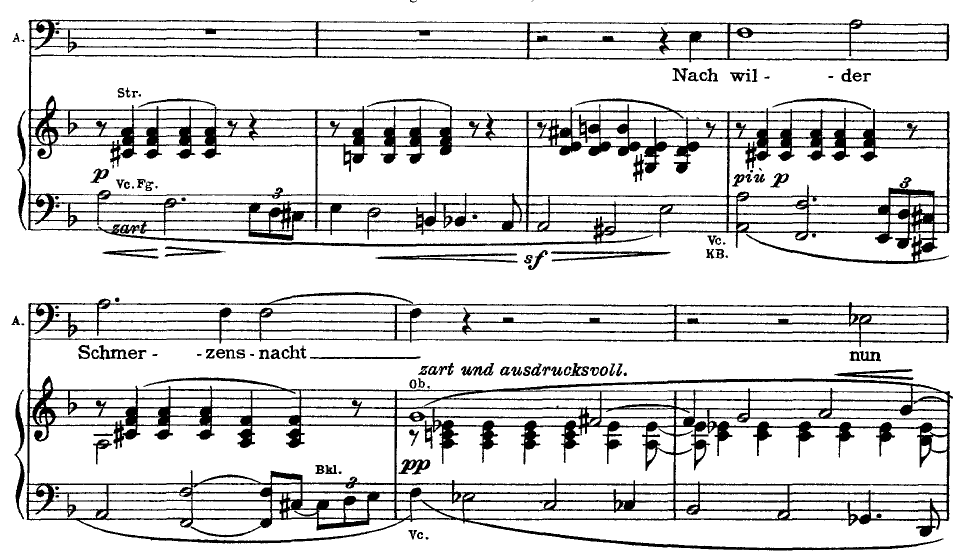
The most audible part of this motif are the violin and viola sections, which together trace a pulsating quarter-note chord. What is particular to this chord is not its quality but its dissolving syncopation. In this case, the motif begins with four chords, and is bracketed by eighth and quarter rests, which gradually expand into five chords and eighth rests, and finally to a constant pulsation with no rests. The diminishing intervals reflect the constancy of Amfortas’s mounting pain that herbs only relieve temporarily. These diminishing intervals also sound like an emergent yearning. A descending melodic line underneath these recurring waves of pain is played by cello and bassoon, which taints the motif with a lower register, and a dark memory.
In an extended recitative, Gurnemanz recalls Amfortas’s salvation. “In a holy vision, [Amfortas] saw the shining words: ‘Enlightened through compassion, the innocent fool; wait for him the appointed one.’”9 It comes as no surprise that Parsifal, a foolish youth, duly appears on stage after Gurnemanz says this. But it is surprising that when he enters the stage, a swan, bleeding, careens through the air, before “fall[ing] to the ground, exhausted.”10 When Gurnemanz questions Parsifal about the swan’s sudden death, Parsifal answers “Indeed! Whatever flies I can hit in flight!”11 Although the youth almost immediately shows remorse and “breaks his bow,” his entrance is disturbing, and reveals his tendencies as a natural man.12 From what little Parsifal remembers of his own past, he knows that he was raised in the woods.13 His slaying of the swan strikes the Knights as immoral and unequivocally wrong; but Nature, Parsifal’s educator, bears ultimate responsibility for his folly. Wagner’s subtle indictment against Nature here will be made explicit in the later Good Friday Music.
Gurnemanz’s wrath towards Parsifal quickly gives way to curiosity. Could this be the fool who will be Amfortas’s saving grace? Gurnemanz’s test is to take Parsifal to the Grail Castle and watch for hints of compassion in his reaction to the communion ceremony. What Parsifal witnesses there is a father-son drama. Titurel, Amfortas’s father, entreats him to uncover the grail, which restores the immortality of the Grail Knights. Amfortas cries, “No! Leave it covered! Oh, no one must know the torment that this sight arouses in me though it delights you!”14 15
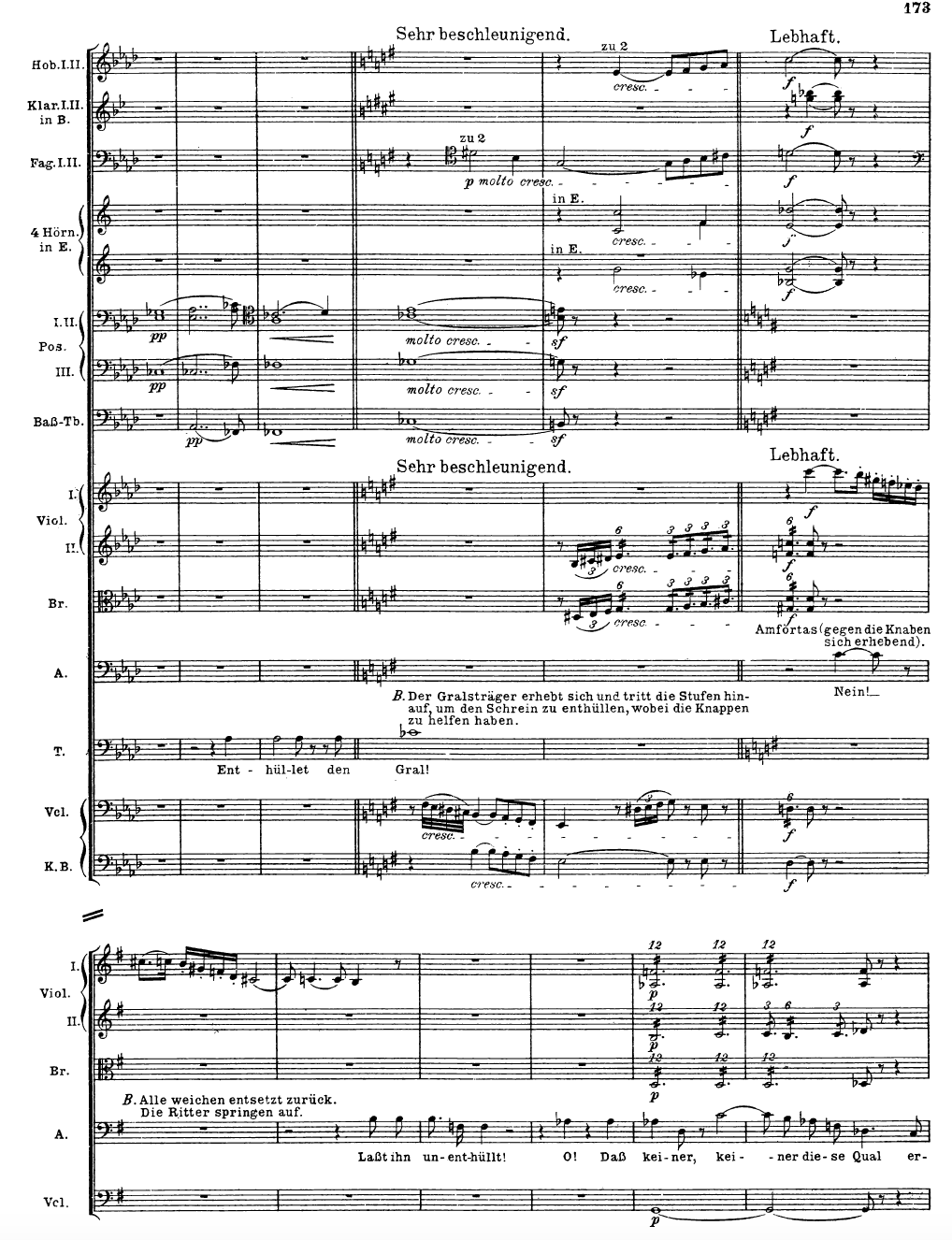
In the mostly diatonic world of the Grail, a new motif of Amfortas’s Suffering leaps to the ear, agonized and burning. It begins with the shriek of a chord played in the horns which is further supported by the middle and low strings. After the chord, the first violins gallop down the scale before halting in their lower range. This motif captures both Amfortas’s guilt towards his father, and the consuming pain which prevents him from performing his office.
Both the Pain and Suffering motifs in Act I have a personal character. They mostly play for Amfortas and reveal his interiority, inaccessible to anyone else. Yet Amfortas’s solitude is broken in Act II, which begins when Parsifal appears in Klingsor’s castle. There, he is quickly subjected to three challenges of increasing intensity. In the first, he quickly dispatches Klingsor’s guards. Next, the challenges take an erotic turn. He encounters a group of flower maidens who try to seduce him. Despite their attractive beauty, their bickering annoys Parsifal, and he pushes them aside. Finally, he meets his greatest challenge, Kundry. Her seductive method is unintentionally pedagogical. In her monologue she feeds Parsifal tantalizing morsels of self-knowledge–something he seems to lack entirely–although Kundry already told him most of these details in Act I.16 Kundry’s first instruction is to name him “Parsifal!”17 He is surprised: “Parsifal? My mother called me that once in a dream.”18 Kundry has an onomastic explanation, “I named you, pure foolish one, ‘Falparsi’ — you pure fool ‘Parsifal.’”19 In a letter Wagner writes that this was an etymology of his own invention! “This is a Arabian name…‘Parsi fal’ means: ‘parsi’…‘pure’; ‘fal’ means ‘mad’ in a higher sense, in other words a man without erudition, but one of genius.”20 Wagner’s etymology is unintentionally playful, but his intent is serious: names contain a person’s essence.
Kundry then briefly speaks of Parsifal’s father, Gamurent, who died in a far away land before spending the rest of her seduction on Parsifal’s mother, Herzeleide, who died after Parsifal left her. It is this proto-Freudian parental appeal that most touches him, and he says with emotion: “Alas! What have I done? Where was I? Mother!” a cry of anguish that mirrors Amfortas’s parental guilt towards Titurel.21 Kundry then positions herself as the antidote for his distress, saying, “this calamity, this distress can be removed through the comfort of love.”22 It is after the talking has stopped, and Kundry kisses Parsifal, that he receives his greatest lesson. He shouts “Amfortas!” and the Suffering motif plays after a fermata:23
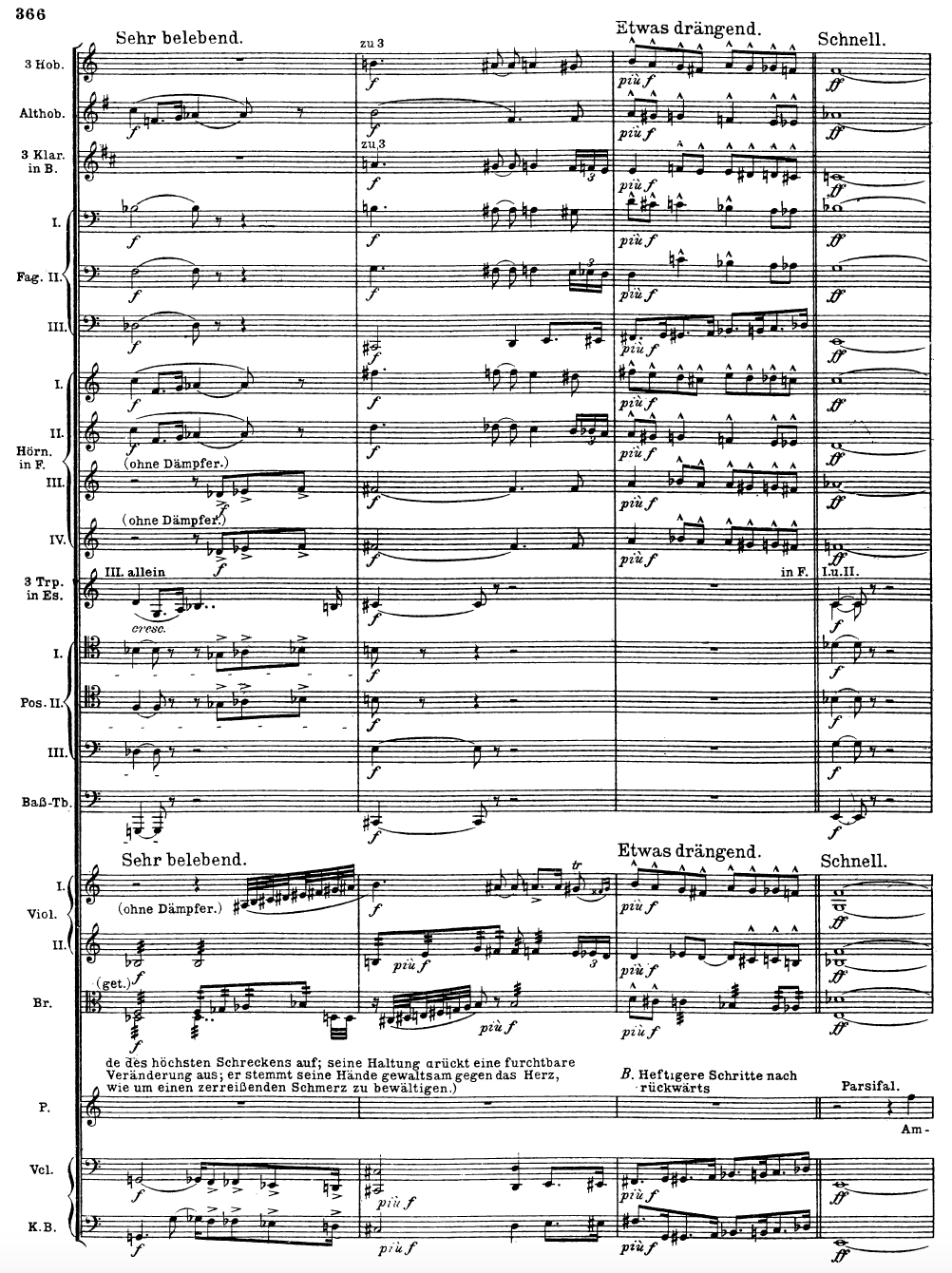
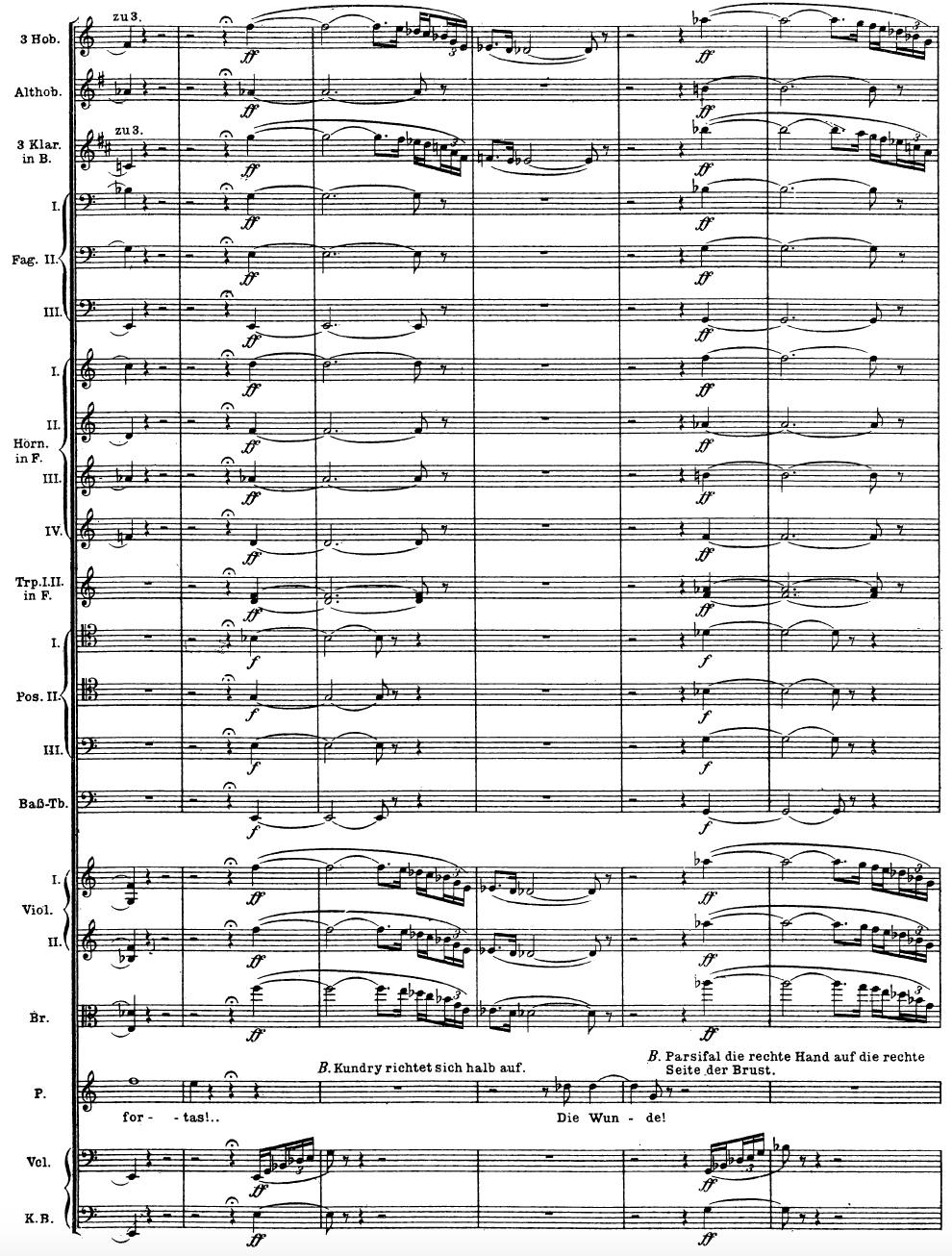
At this moment the mystery of the wound is resolved: Parsifal now understands Amfortas’s psyche through their union in the Suffering motif. This higher order musical sympathy is borne out in Parsifal’s physical response. After crying Amfortas’s name, he continues, “The wound! It burns in my side!...The wound I saw bleeding now bleeds in me!...Oh torment of love! How everything trembles, quakes and quivers in sinful desire!”24 Parsifal’s compassion towards Amfortas is not an abstract kind of knowing about the wound but a bodily feeling.
A union of sufferer and sympathizer has precedence in the work of Wagner’s favorite philosopher, Arthur Schopenhauer. In his essay On the Basis of Morality, Schopenhauer posits that compassion is the basis for all “free justice and all genuine loving kindness.”25 His claim is immediately followed with an acknowledgement about the difficulties that compassion entails. “All human actions, as a rule, spring from Egoism.”26 That is to say, if every human is self-interested, how can one genuinely act for another’s interests? Schopenhauer’s solution:
Another becomes the ultimate end of my will just as otherwise, I am; and so through this: that I immediately will his well-being and do not will his woe, just as I otherwise immediately will only that of my own. This, however, necessarily presupposes that I suffer along with his woe, feel his woe, as otherwise I would only mine, and therefore, I immediately will his well-being as, otherwise, I would only my own.27
If two people share a mind and body, then their drives are the same and each acts wholly for the other’s interest. By merging the wills of sufferer and sympathizer, Schopenhauer provides a concrete means–but admittedly difficult means–by which to realize compassion.
Leo Tolstoy, who was as much a student of Schopenhauer as Wagner, also presents pure compassion through unity in War and Peace. When Prince Andrei passes by the Oak Tree in Otradnoye for the second time, he aspires to no longer be selfish.
It’s not enough that I know all that’s in me, everyone else must know it too: Pierre, and that girl who wanted to fly into the sky, everyone must know me, so that my life is not only for myself; so that they don’t live like that girl, independently of my life, but so that it is reflected in everyone, and they all live together in me!28
What separates Wagner from Tolstoy, however, is that Wagner adds emotive impact through music to unify Parsifal and Amfortas. Yet, Schopenhauer, and by extension, Wagner and Tolstoy, are ultimately indebted to the Gospel for this idea. “Love your neighbor as yourself.”29
But Parsifal’s epiphany is triggered by Kundry’s kiss. It is through the kiss that Amfortas’s experiences are unlocked for Parsifal. The necessity of erotic experience complicates the opera. Gurnemanz had earlier suggested that Eros posed the greatest danger to the Brotherhood. Klingsor “transformed the desert into a garden of bliss in which bloomed women of devilish beauty. Now he lures the knights into sinful joys and hell’s damnation. Many have already succumbed.”30 Klingsor’s land of seduction and Eros were to be avoided at all costs. And yet the kiss unlocked genuine compassion. So, Wagner’s attitude towards Eros in Parsifal thus far seems to defy simple classification. It is both dangerous and essential to experience.
Returning to the action, with Kundry’s seduction foiled, Klingsor hurls the Holy Spear at Parsifal in a final, desperate attempt to smite him. But the Spear refuses to break flesh and “remains poised above his head.”31
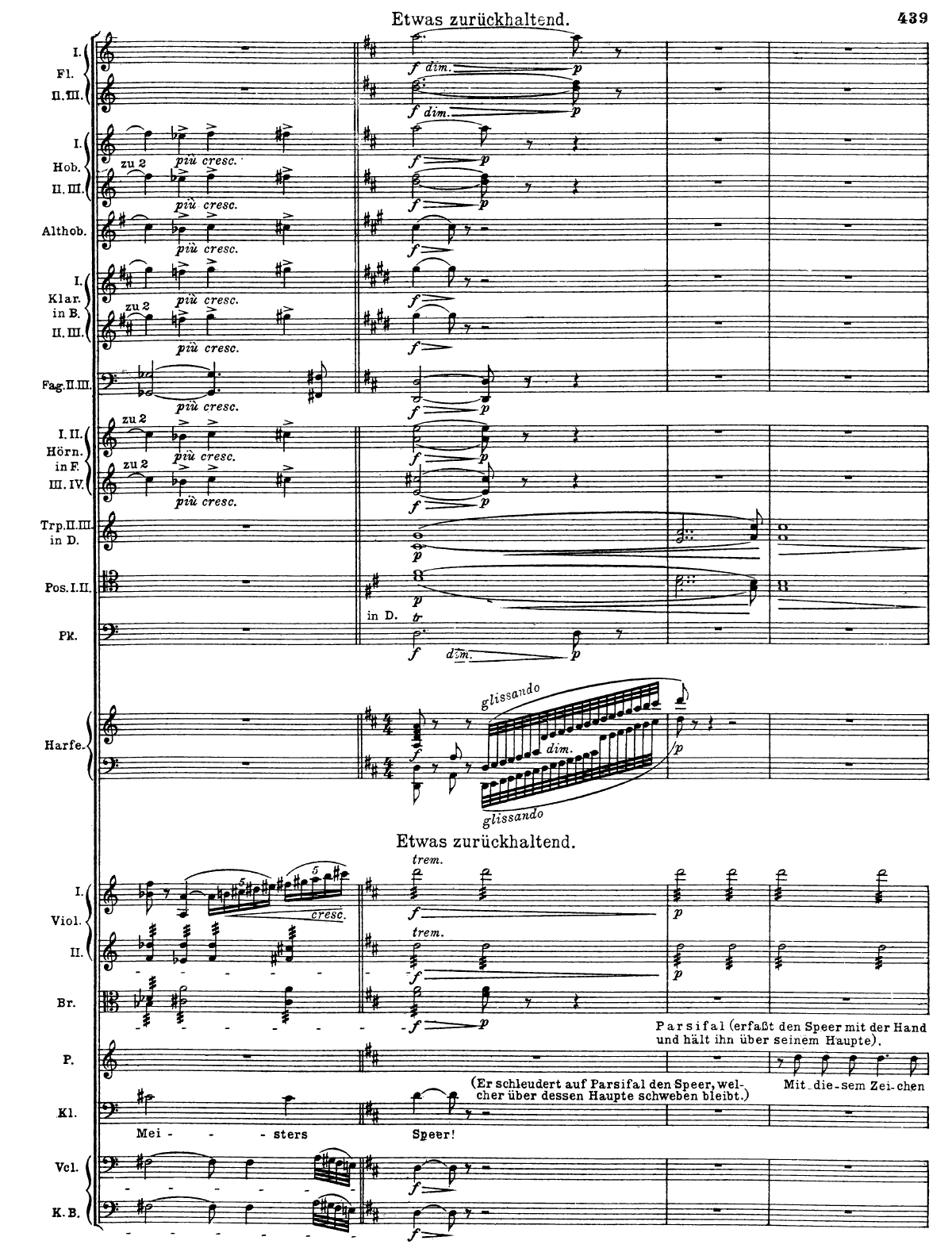
Parsifal snatches the Spear from the air and makes the sign of the Cross.32 Klingsor’s domain collapses and the curtain falls.
II
The final act begins with Gurnemanz and Kundry in “the domain of the Grail. A pleasant, open spring landscape with a background of gently rising flowery meadows.”33 This is the same location as Act I, but the “solemn forest” has been replaced with flowers in bloom.34 Renewal is in the air. When Parsifal arrives a waterfall of baptisms and sacred anointments begin. First, in a direct imitation from Luke, Kundry washes Parsifal’s feet in the holy spring and dries his feet with her hair.35 Then, Gurnemanz sprinkles Parsifal’s head with water, Kundry anoints Parsifal’s feet with oil, and Gurnemanz anoints Parsifal’s head. Throughout this sequence the voice of the orchestra is steadily becoming more prominent. In the penultimate action of the sequence, Parsifal baptises Kundry and turns his gaze towards the meadows. When he “gazes on the wood and meadow” the orchestra completes its steady progression and speaks out with a newfound lyricism.36 Parsifal’s look shows both that he is attuned to Nature and can hear the music, and that Nature feels willing to play for him. The key audibly changes from A Flat Major to B Major and a symphonic phrase plays, without voice, the Good Friday Music.37
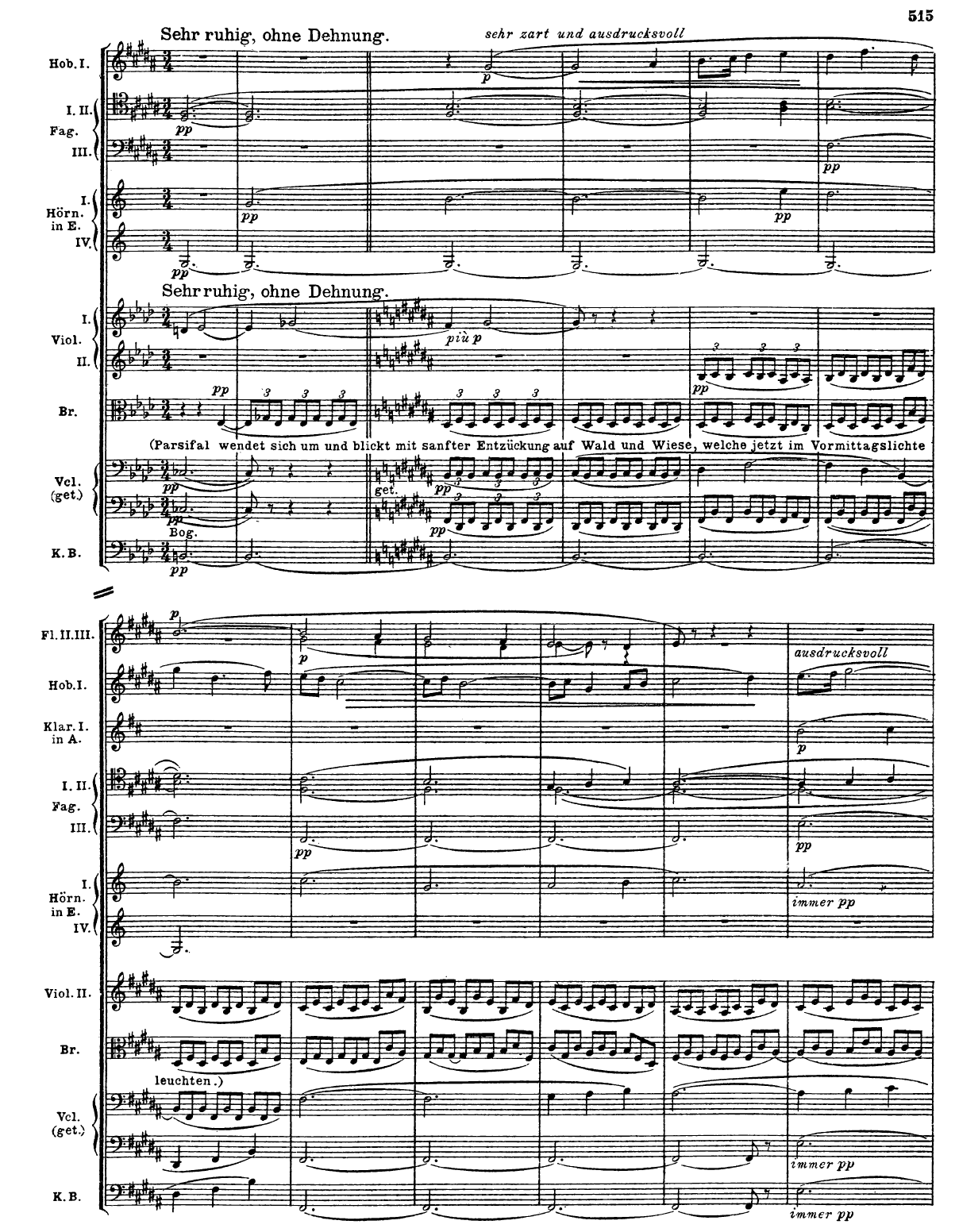
First outlined by the oboes and supported by the clarinets, this phrase is unprecedented in the opera. We hear peace. Infinite tenderness, held by a gentle warbling in the strings. Dark turns in the upper strings recur but only to quickly fade into the weave of the Good Friday melody.
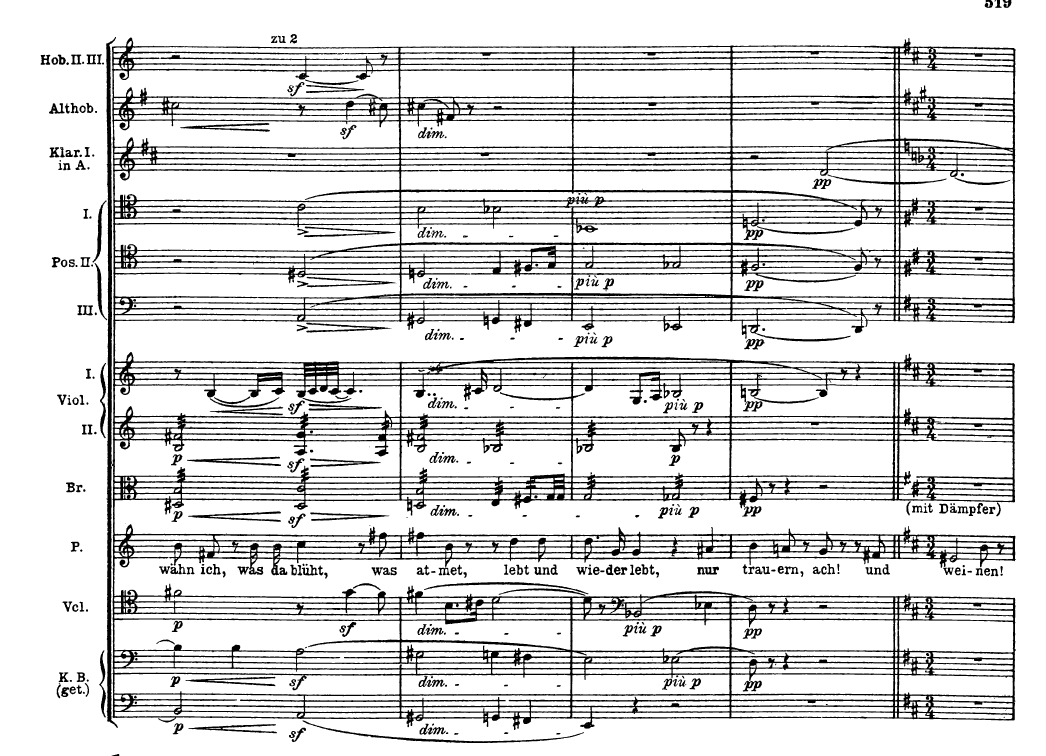
Tragedy becomes memory, and all is absolved. Next, this unprecedented peace bursts into rapturous joy when the strings take the melody from the woodwinds and soar near the top of their range.
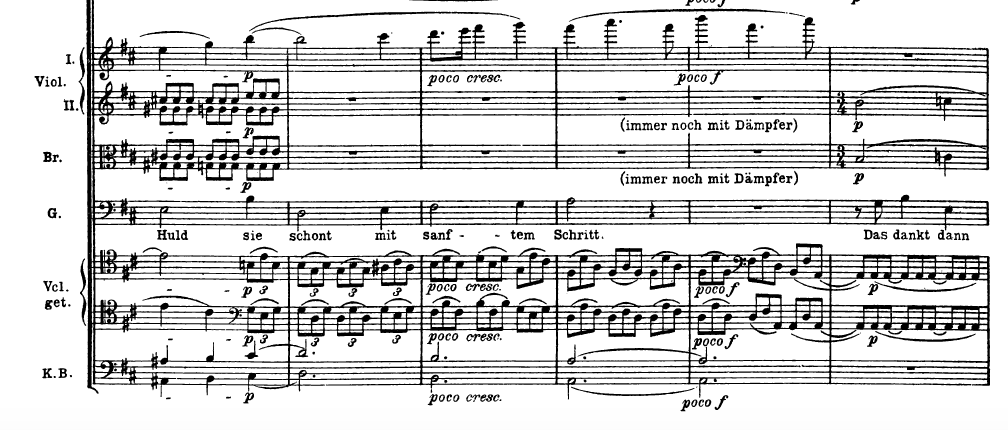
Throughout this sequence the orchestra is united. Here, a three note phrase swirls through each section:
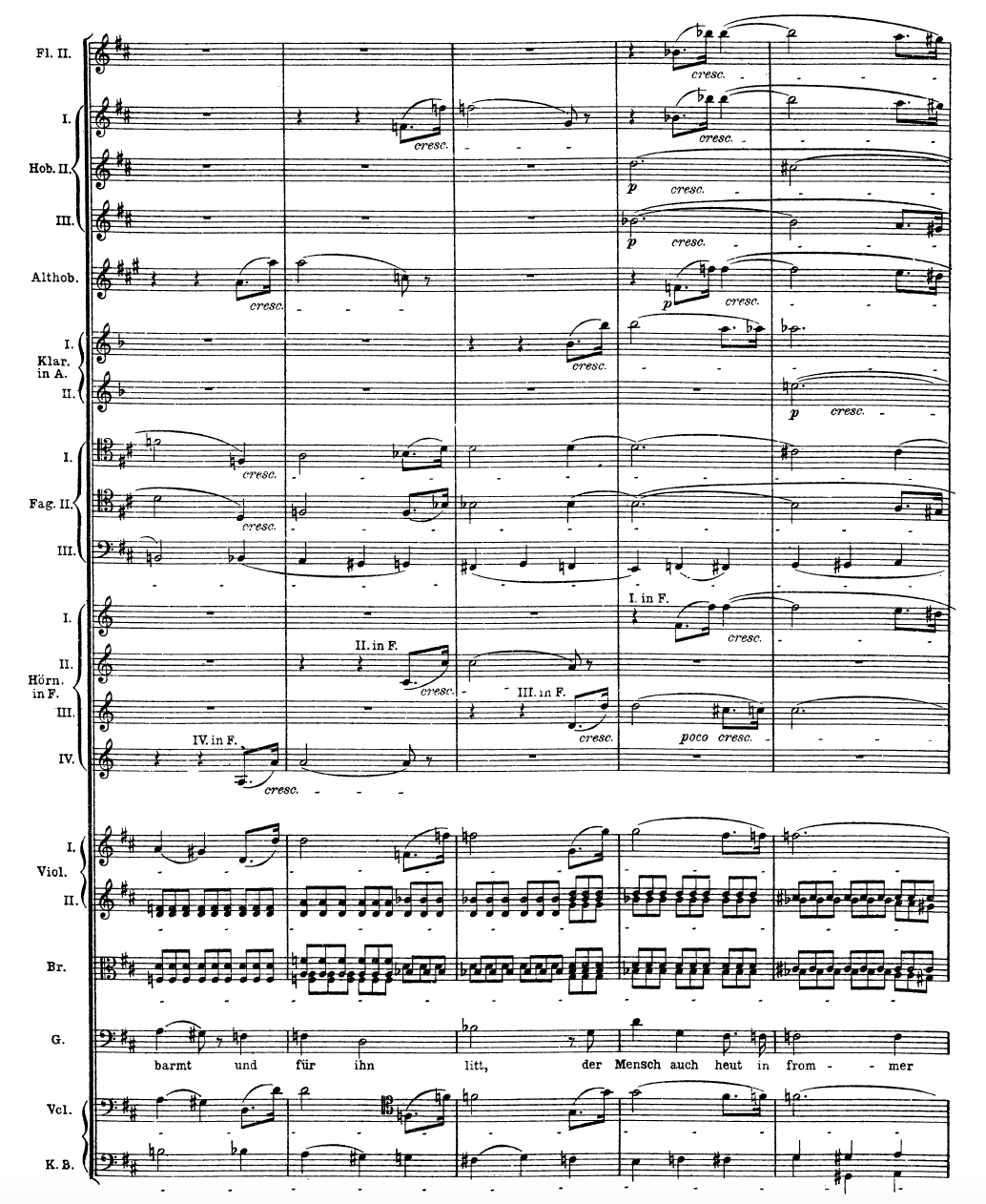
But most importantly, we hear the emergence of a new personage, Nature. After a brief moment of pure music, Gurnemanz starts to speak:
The grasses and flowers of the meadow know that today the foot of man will not tread them down, just as God with divine patience pitied mankind. Thus all creation gives thanks for all that here blooms and soon fades, now that nature, absolved from sin, today gains its day of innocence.38
In the Good Friday Music, Gurnemanz and Parsifal describe Nature in a human way. It “rejoices,” “smiles,” and can be “absolved from sin.”39 Nature is on stage and in the music. She has come for the baptismal font. Yet, Nature will not be baptised by the increasingly Christ-like Parsifal, but rather by Kundry, who is overcome with emotion. As Parsifal observes: “Your tears become a dew of blessing: you weep–and see, the meadow smiles!”40 She “sprinkles the meadow with holy dew, and now all nature rejoices at the Saviour’s sign of love.”41
The Good Friday Music flows between and unites all the baptisms and anointments–Parsifal’s, Kundry’s, and Nature’s. The music has a similar function to Parsifal’s and Amfortas’s Suffering motivic link in the previous act. But what does this musical unity here mean? Is there a higher principle, as with Parsifal and Amfortas, that undergirds it?
During the Good Friday Music there is a remarkable reconciliation of Kundry and Parsifal. One of the last actions of Act II was Kundry casting a curse on Parsifal so that he might never again find the land of the Grail or Amfortas.42 Act III begins many years after Act II. Parsifal has had to wander and fight to survive in the interim. Despite Parsifal’s redemptive last words, “you know where to find me again” one would expect them to be enemies.43 But in their first interaction, Kundry “bathes Parsifal’s feet with humility. Parsifal watches in silent wonder.”44 In return, Parsifal’s first duty as King of the Grail (his ascension will be discussed in Section III) is to baptise Kundry. When he does, she “bows her head to the ground and appears to be weeping bitterly.”45 From these interactions, it is clear that their animosity has transformed into tender love and understanding. There has been a great agapic epiphany in Kundry–as there had been with Parsifal in Act II. Her love is no longer weaponized, but genuine. Parsifal’s wonder at Kundry’s change of heart amplifies the good feeling he shows her. This compassion has the power to bridge the greatest of divides.
Again War and Peace comes to mind: Prince Andrei, like Parsifal, shows great compassion towards his enemy Anatole Kuragin. When both men are injured and lay dying in a battlefield hospital, Andrei cannot at first recognize him. But after a memory comes to him of Natasha, he “remembered everything, and a rapturous pity and love for this man filled his happy heart.”46 A moment later a ring of Parsifal’s prophecy can be heard in Andrei’s closing reflection: “Compassion, love for our brothers, for those who love us, love for those who hate us, love for our enemies…that's what was still left for me, if I were live.”47
For Andrei, Parsifal, and Kundry, compassion is the meaning of life. Compassion has even changed the meaning of the holy spear. Of his time searching for the lands of the Grail, Parsifal says: “I received many wounds, for this Spear I dared not use in battle.”48 This is distinct from Amfortas, who wielded the holy spear in battle against Klingsor.49 For Parsifal, the Holy Spear is no longer a weapon to be defiled in combat but a holy relic to be preserved even if it means risking his life.
Nature’s baptism in the Good Friday Music reveals that it too underwent an agapic transformation. In the previous two acts, the principle of Nature was predation. Recall Parsifal killing the swan and the name of the women who attempt to seduce him in Act II: ‘Flower’ Maidens, and Kundry, whose epithet is ‘wild.’50 It is they, under Kingslor’s aegis, “who lure the knights into sinful joys and hell’s damnation.”51 But in the Good Friday sequence, Parsifal discovers they have changed.
How very beautiful the meadow seems today. Once I came upon magic flowers which twined their tainted tendrils about my head. But I have never seen the grass and flowers so fresh and charming, nor smell so sweet and child-like, nor speak with such tender love to me.52
In a transformation which mirrors Parsifal’s relationship with Kundry, Nature now speaks with tender love towards Parsifal, instead of moving him to kill or trying to destroy him.
The disarmament of Parsifal, Kundry, and the Flower Maidens has broader symbolic meaning. The Holy Spear symbolizes the phallus and, more broadly, the masculine. Like a spear, the masculine is inherently dangerous. By contrast, the Holy Grail, which symbolizes the womb and the feminine, is not a weapon. In the classical understanding, the feminine is passive toward the masculine.53 Thus, when faced with a threat like the Spear, wild Kundry and the Flower Maidens have to appeal to their art of seduction to defend themselves. They in turn wound the masculine, which reinforces the aggressive instinct of the Spear, triggering a cycle of animosity. At the end of Act II, when Klingsor throws the spear at Parsifal, it stops before hitting him, and the dangerous character of the phallus is annulled. In turn, the feminine is freed from her arts and the necessity of self-defense. Nature frustrates symbolic sexual harmony. The phallus first manifests itself as a weapon and triggers this cycle; but what Wagner is suggesting is that Nature can be guided and reshaped.
Drawing on a longstanding interest in eastern religion, in his essay On Religion and Art, Wagner elaborates more explicitly on the mutability of Nature’s nature. He begins by extolling the “profound metaphysical insight…when the Brahmin pointed to the manifold appearances of the physical world and said ‘This is thyself!’”54 We are in all things and they are us. This teaching was centered in the “recognition of the unity of all that lives.”55 If it is metaphysically true that all things are united, it seems a contradiction that all things should prey on each other–and that the masculine and feminine should be stuck in a cycle of aggression. The Good Friday Music is positioned within this debate. In it, Wagner redefines Nature’s nature as compassion and frees the masculine and feminine from Nature’s dark influence. To put special stress on these words of Gurnemanz: “All creation gives thanks for all that here blooms and soon fades, now that nature, absolved from sin, today gains its day of innocence.”56
The Good Friday Music could have ended the opera. After the melody fades out, however, a peal of bells are heard in the distance which seamlessly begins a new musical sequence, the Transformation music.57
III
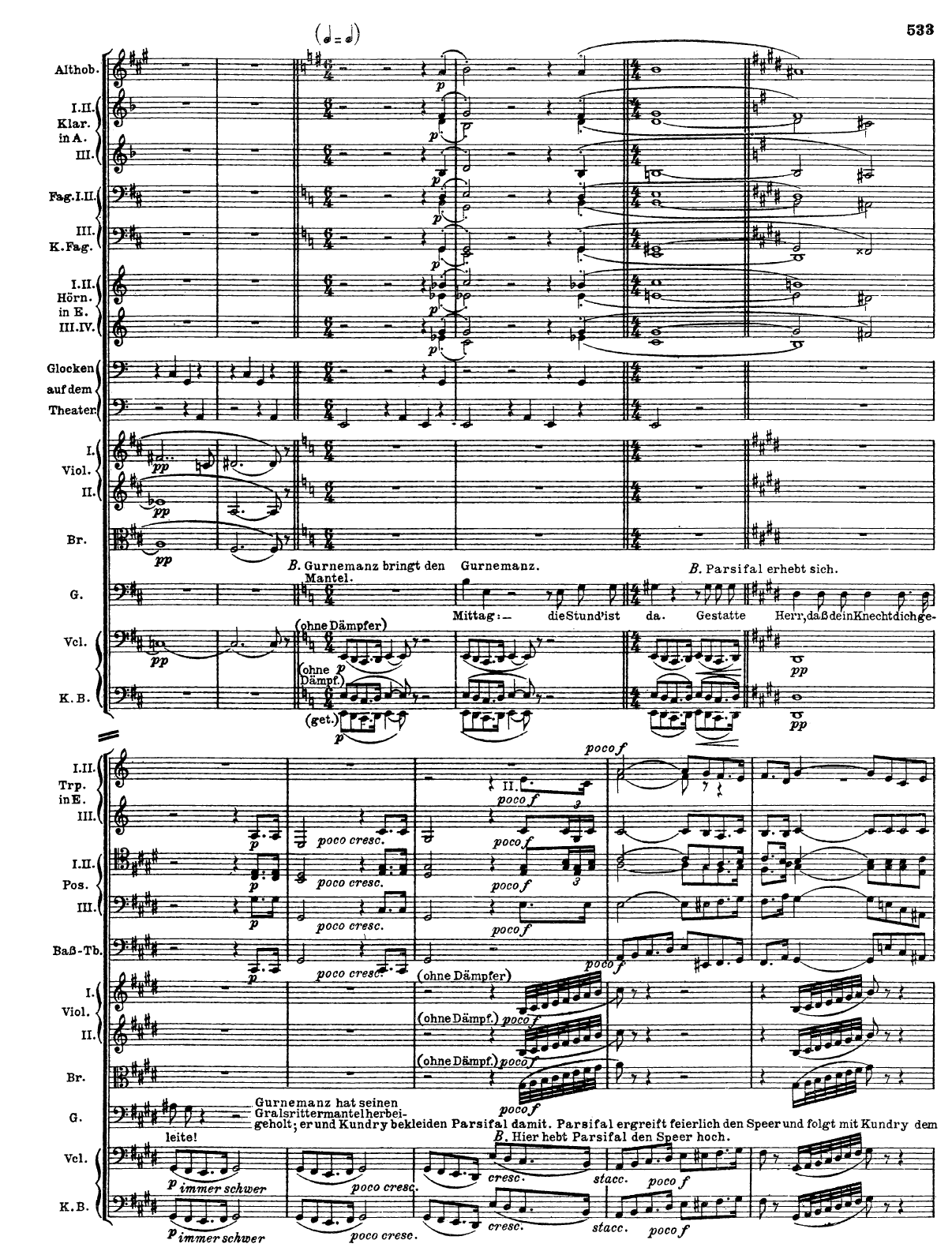
Perhaps the clearest aim of the Transformation Music is to signal a scene change from Grail Forest to Castle. But Wagner is thinking more expansively. “The scene gradually changes, as in Act One. After remaining visible for a while, the three [Kundry, Parsifal and Gurnemanz] disappear completely from sight as the forest gradually vanishes and cliffs take its place.”58 Instead of a curtain drop and scene switch, Wagner and the music insist that the two locations gradually become one another. This quasi-mystic modulation amplifies the sanctity of the Grail Castle. As in Act I, it is not a place which has a physical manifestation that can be traveled to and accessed. As Gurnemanz puts it earlier: “No earthly path leads to it and none could tread it whom the Grail has not guided.”59 As Parsifal notices, “I scarcely tread yet already seem to have come far.”60 The Grail castle is a place that one must be called upon to access. But if you are called, “time becomes space” and it can be accessed from anywhere.61
A journey is told in the Transformation Music. The distant bells mimic heavy footsteps, and set a pedal tone in the low register; reminiscent of the heavy organ steps in the opening bars of J.S. Bach’s St. Matthew’s Passion. But unlike Bach, the cellos and double bass take over for the bells and repeat a similar, but different eight-note pedal tone for nearly the entire sequence.
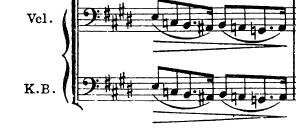
However, this ostinato has a further effect than travel mimicry: it creates a clear division in the orchestra. As the low strings and bells repeat the same phrase with slight step-wise alterations, the horns, woodwinds and upper strings trace chords that strain against the bass’s harmonics:
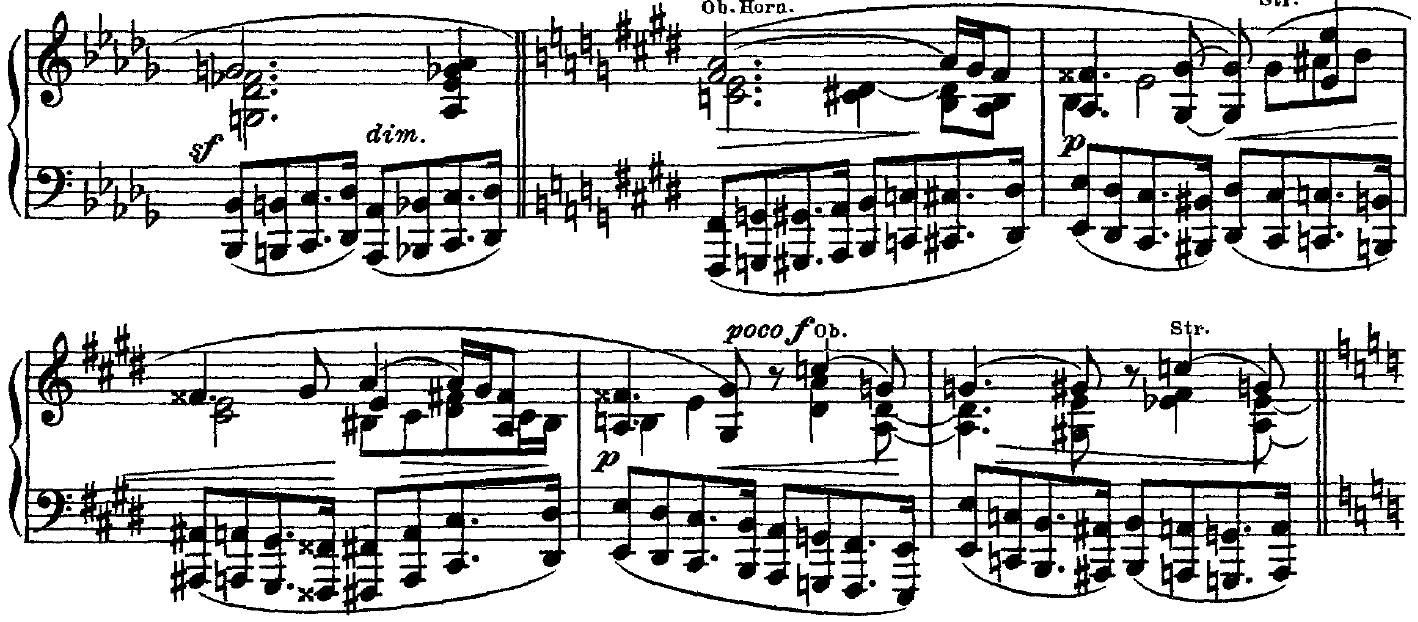
After the Good Friday Music’s unity, a divided sound is surprising. Still, when considering the broader political shift which this moment leads up to, the music fits into a whole. One may think that after Parsifal’s moment of sympathy in Act II, all his intentions would be towards healing Amfortas’s wound and helping him to again fully preside over his order. But when he returns to the Grail lands in Act III, Parsifal says to Gurnemanz, “Let Titurel’s knight anoint my head and greet me today as king!”62 Amfortas’s crown is part of Parsifal’s calling. Can we hear the harmonic tension as a political revolution? If so, then together the Good Friday Music provides the theoretical precepts upon which one should live, and the Transformation Music shows the implementation of those ideas in society.
Importantly, the revolution which Parsifal leads in Act III is nonviolent. Divided as the Transformation Music sounds, the respective voices do not antagonize each other. No war in music! According to Gurnemanz, Amfortas’s crown is his “final burden.”63 When Parsifal lifts it from his head it is the act of one “so pure, so compassionately enduring.”64 As unlikely as it might seem that any king would want to part from his power, Amfortas’s duty as king magnifies his suffering. Before Parsifal enters the Grail Castle in Act III, it is revealed that Amfortas has sunk further in despair and seeks only death. It is to this end that he has refused to uncover the grail and restore his own vitality and the knight’s vitality. All have felt the consequences of his decision. When Act III opens on Gurnemanz, he is “now a very old man.”65 Most tragically, Amfortas’s father, Titurel, has died due to Amfortas’s suicidal urge. In an especially cataclysmic moment, Amfortas’s knights all urge him in a unified chorale to “Reveal the Grail! Perform your duty! Your father exhorts you. You must! You must!”66 67 Amfortas answers, “No! No more! I feel death already closing around me; should I then return to life? Madmen! Who shall compel me to live? But you could give me death!”68
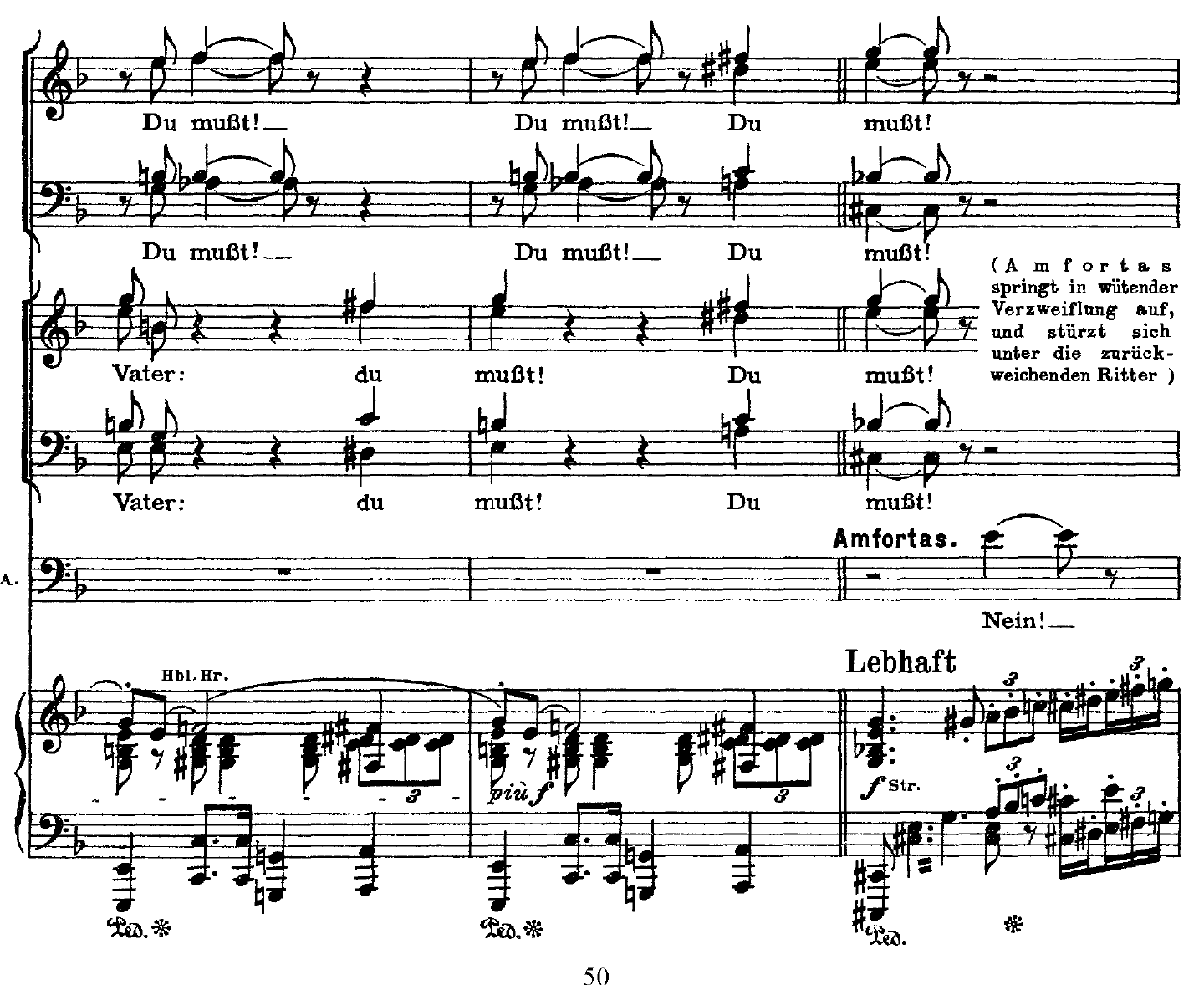
Parsifal’s takeover cannot be called a coup-d'etat. Rather, it is a necessary political transformation. It comes to a head when Amfortas reveals his wound and calls out to his knights, “take out your weapons and thrust them down to the hilt!”69 As they draw their blades, Parsifal rushes in, touches the Holy Spear to Amfortas and heals the wound. He declares to Amfortas, “You are whole and have atoned! I shall now perform your task. Blessed be your suffering that gave compassion and wisdom to the timid fool!”70 When the Pain motif plays during this moment, we hear it differently than before:71
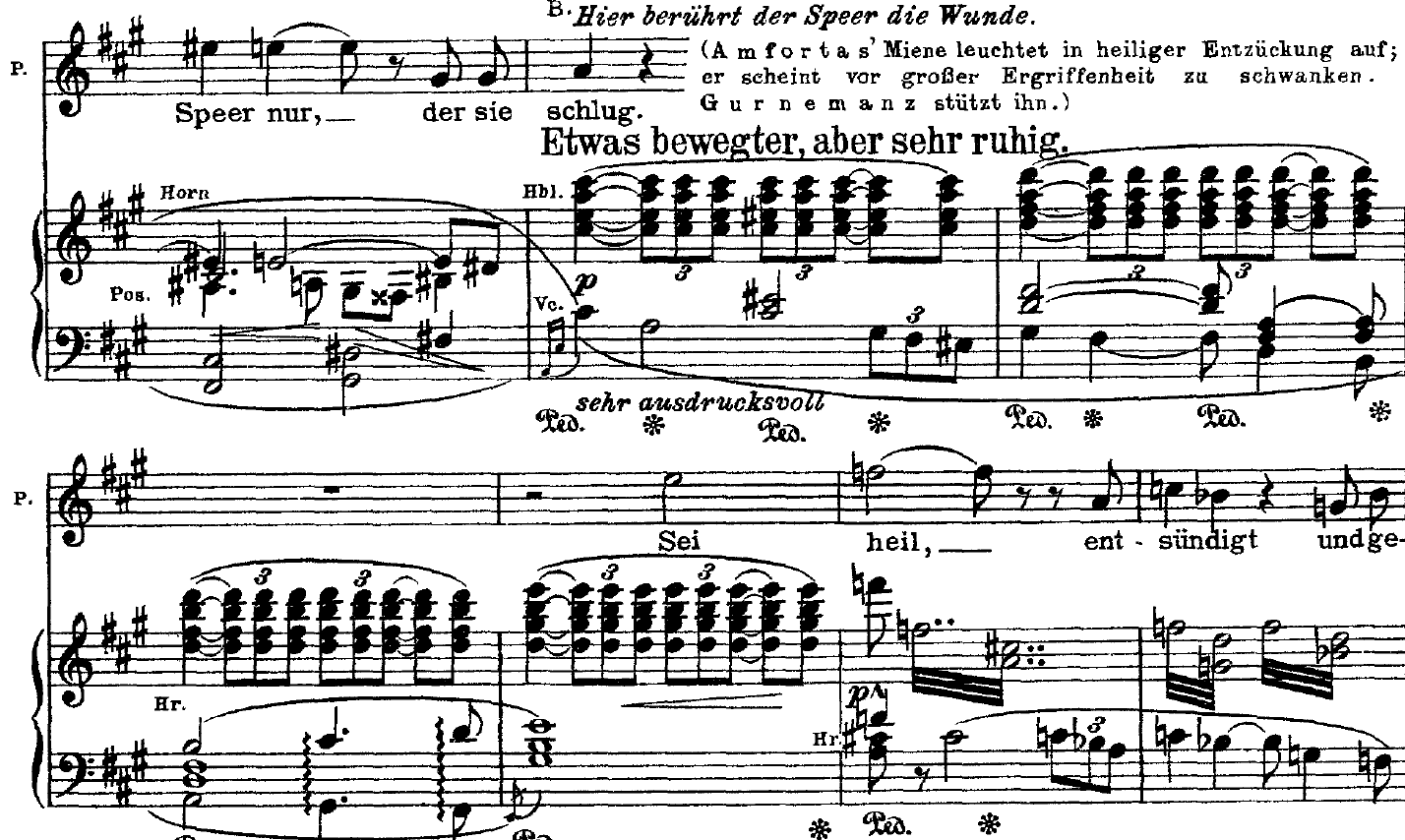
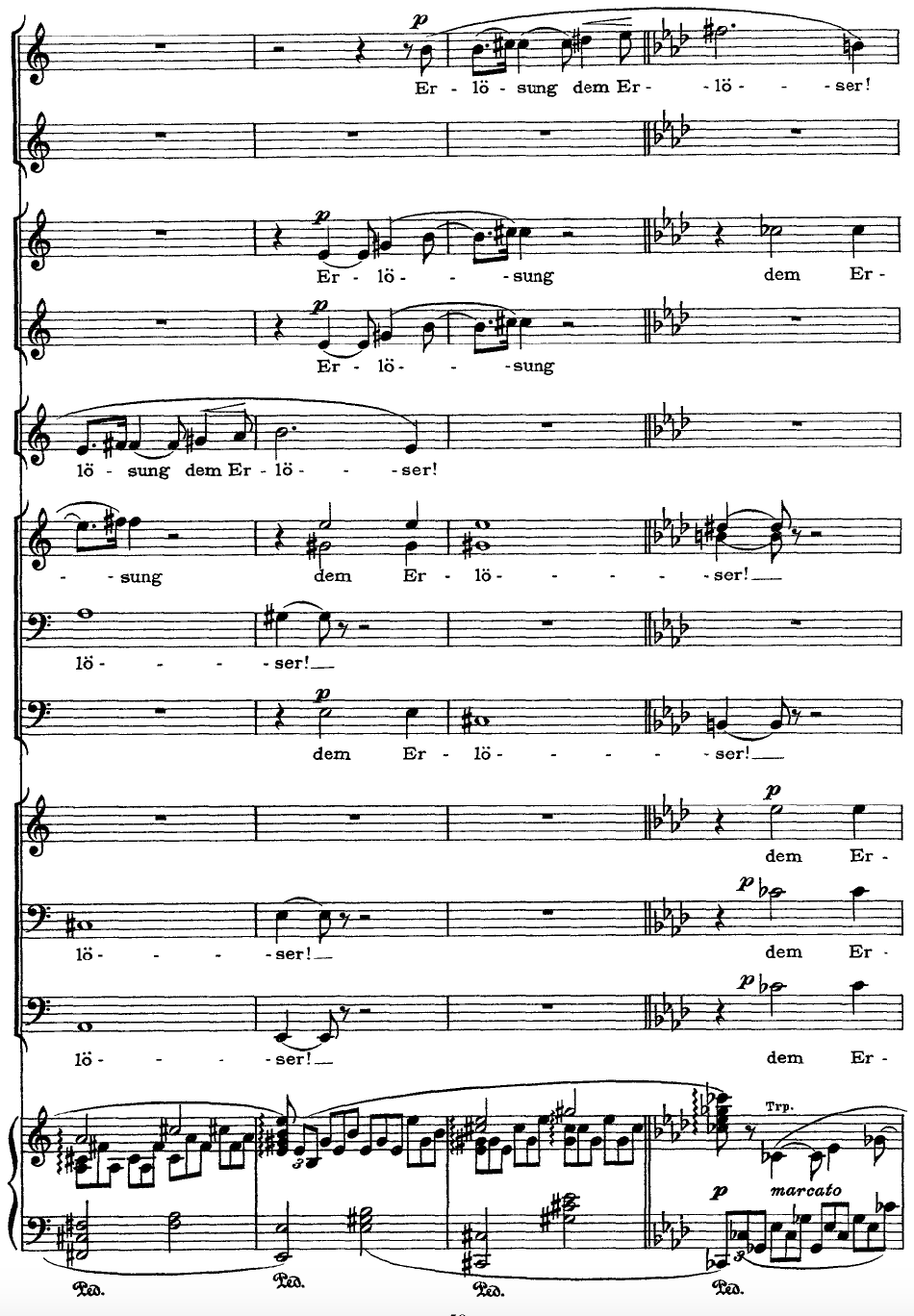
When the pulsations collapse into a tremolo, the Pain motif has collapsed, and Amfortas’s pain is over. Parsifal then performs the rejuvenating rite for the order and reunites the Holy Spear and Grail. The Knights praise him, “Redemption to the Redeemer! Oh wonder!”72 73
Although the Knights of the grail are granted access to Parsifal’s new order, Kundry noticeably is not. As the music soars to the unspeakably beautiful finale “a white dove descends and hovers on Parsifal’s head” and “Kundry sinks lifeless to the ground in front of Parsifal, her eyes uplifted to him.”74 A straightforward way to understand her death is that in Parsifal’s order, women are not allowed; only men can attain self-mastery, so this order must be all male. This reading, however, underestimates the critical role Kundry has played throughout the opera. Her kiss enlightened Parsifal to the true meaning of compassion. Her tears baptized Nature. Given her centrality, a more compelling interpretation is that her death is her redemption. She recounted in Act II how she laughed at the “Savior” on the cross.75 It takes some filling in from Gurnemanz and Klingslor to infer that she can be identified with the myth of the Wandering Jew: a non-canonical woman who laughed at Jesus on the Cross and was cursed to walk the earth forever. But the curse in Wagner’s mind takes on a distinctly Buddist slant. Klingsor calls her, “you nameless one, She-devil of old! Rose of Hell! Heroidas you were–and what else? Gundryggia there, Kundry here!”76 Instead of being immortal as the myth usually has it, she is stuck in an infinite cycle of reincarnation. When she sinks, lifeless, it is the ultimate act of redemption for her earlier sin and a release from the prison of rebirth.
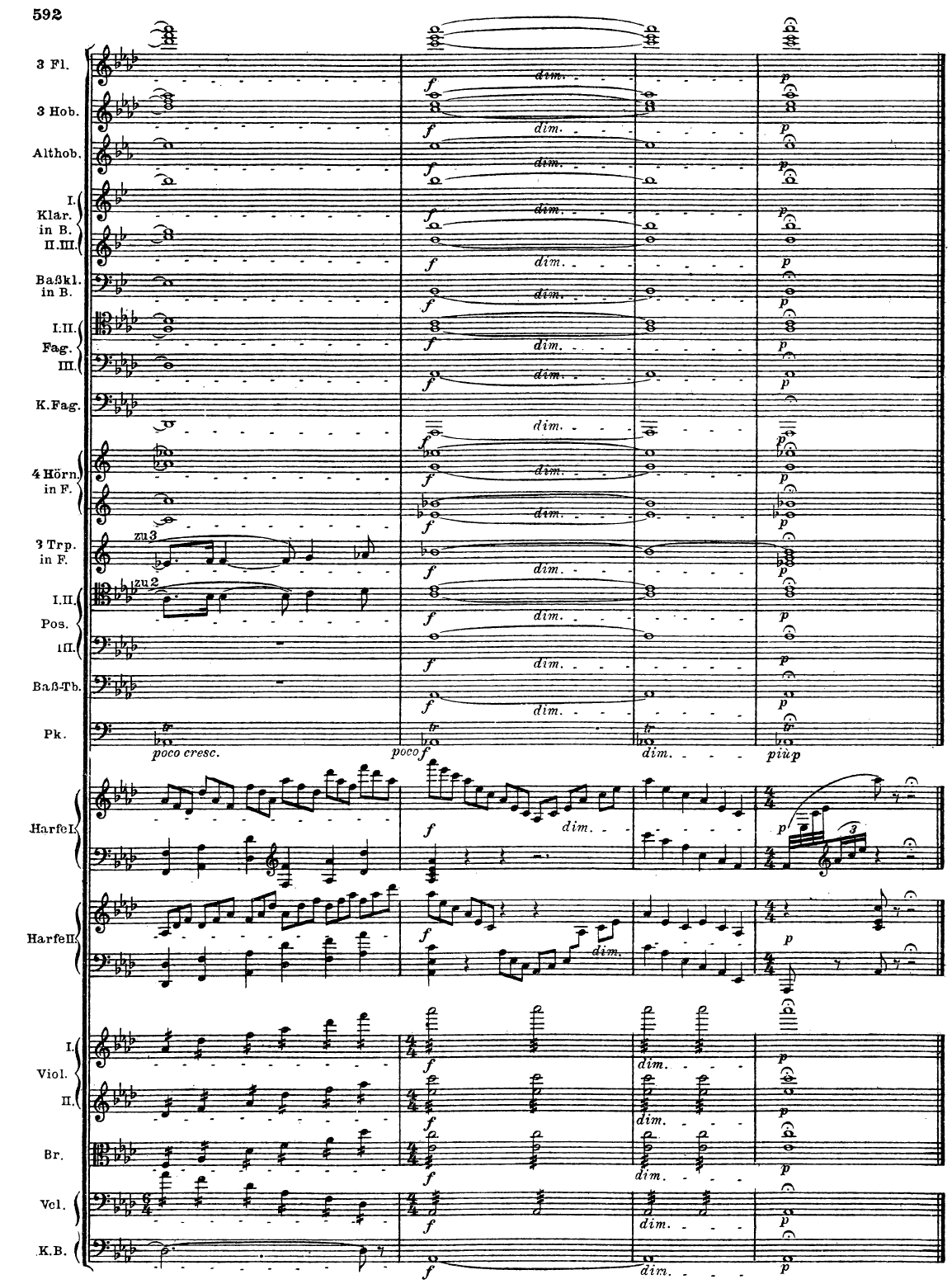
The capstone to Parsifal’s politics is the unification of the symbols of his office, the Holy Spear and the Grail. The Knights gaze at the Spear and say, “Oh supreme joy of such a miracle!” The Spear and Grail are placed next to each other in symbolic sex and the music speaks alone in the finale. Two harps join the ensemble, fortifying an ascension to the tonic A-Flat Major, and the curtain closes.
Postlude
Nietzsche’s critiques of Parsifal may be more renowned than the opera itself. But now that Parsifal has been examined on its own terms, his critique can be assessed. Nietzsche avoided going to Bayreuth to hear the opera, and did not have a score. The only vestige of Parsifal in his library is the libretto, a personal gift from Wagner.77 Nietzsche was a good piano player and had a developed ear–he was ravished by the prelude–so he can be called a legitimate critic of music. Concerning Parsifal, his thought is concentrated in two books, The Case of Wagner, and Nietzsche Contra Wagner, and is twofold. First, he claims that two of the opera’s central concepts, purity and redemption, are life-denying. Secondly, and more contentiously, he argues that the permanent principle of Nature is the Will to Power.
The first sign of Wagner’s sickness, in Nietzsche’s judgement, is that the “preaching of chastity…[is] an incitement to anti-nature.”78 Nietzsche interpreted purity (the German is a slightly more ambiguous reiner which can mean purity, chastity, or virginity, which is Parsifal’s epithet) in a strict sense as virginity. In Nietzsche's view, one should “[strive] with all the power of his will to achieve the highest spiritualization and sensualization.”79 Virginity halts an exploration of sex and sensuality, and denies people an essential human experience. Nietzsche is both commenting on Parsifal and insinuating a larger claim about the destructive nature of chastity. One would be inclined to agree that in general, people miss the totality of life if they always remain chaste. But Nietzsche’s critique is doubtful when considering Parsifal in particular. He is not ignorant of Eros. In fact, Wagner stresses the importance of erotic experience when Kundry kisses Parsifal; the kiss was a prerequisite for Parsifal to understand Amfortas. More fundamentally, Nietzsche’s critique begins on the wrong foot. The meaning of reiner is more subtle and expansive than only virginity. Although it is true that Parsifal is a virgin, his most prominent and leading characteristic is that he is deeply compassionate. Epithets usually represent the essence of a person. When Gurnemanz calls Parsifal “so pure, so compassionately enduring,” the concepts of pure and compassion are intertwined.80 What is essential to the meaning of reiner, then, is compassion, not virginity.
Secondly, redemption comes into Nietzsche’s crosshairs for a similar reason.
The need for redemption, the quintessence of all Christian needs, has nothing to do with such buffoons: it is the most honest expression of decadence, it is the most conceived, most painful affirmation of decadence in the form of sublime symbols and practices. The Christian wants to be rid of himself. Le moi est toujours haïssable. (the ego is always painful). Noble morality, master morality, conversely is rooted in a triumphant Yes said to oneself.81
For Nietzsche, redemption presupposes a denial of the will, and a secret desire to destroy oneself. Redemption is central to Parsifal, whose final lines are “Redemption to the Redeemer” so the stakes of this critique are high. Nietzsche thinks that by glorifying redemption, Wagner reveals a secret Catholic identity and that the great composer is, by implication, a life-denier.82 Nietzsche elsewhere calls Wagner “Roman” in the sense of Roman Catholic.83 This is a strong critique but its weight lies not in calling Wagner a Catholic. Parsifal is thoroughly undogmatic. For instance, the most religious moment of the opera, the Good Friday Sequence in Act III, has distinctly uncanonical elements. The occasion, Good Friday, usually a moment of mourning, is explicitly made one of celebration.84 In the sequence of baptisms, Nature herself is baptised–decidedly not a feature of Catholic dogma. Finally, Wagner is explicit in his tinkering with the sacred. The official title of Parsifal is a “Festival Play for the Consecration of the Stage,” not an opera. Although Wagner’s usage of Christian mythology is undeniable, he is unlike any Catholic the world has seen. Indeed, of all people Nietzsche should have praised Wagner for creating his own values.85
Nonetheless, Nietzsche’s assessment that redemption stories are rooted in self-denial requires a more speculative answer. Redemption is always redemption from. In the Christian view it is redemption from the sin of the prehistoric garden of Adam and Eve, which can feel removed from everyday life. However, the opening scene of Parsifal situates us in a distinctly contemporary problem: the estrangement of the sexes. The Grail and Spear are apart from one another in the first two acts, and the distance between them is eventually closed in the final scene. Nietzsche himself recognizes this conflict when he praises George Bizets’ opera Carmen.
“Love translated back into nature. Not the love of a “higher virgin”! [N. is surely thinking of Parsifal here] No Senta-sentimentality! But love as fatum, as fatality, cynical, innocent, cruel–and precisely in this a piece of nature. That love which is war in its means, and at the bottom the deadly hatred of the sexes!”86
For Nietzsche, love is cruel. War between the sexes is a natural, permanent situation, and sex is intertwined with death. Wagner illustrated this outlook in Tristan und Isolde where the titular protagonists die tragically as a result of their love. In Parsifal, Wagner departs radically from Tristan und Isolde and redeems love from ruin. It is in this sense that redemption should be understood. Rather than an escape from life, Wagner’s redemption exalts life in making love supervene over death and war.
The redemption of love makes Nietzsche and Wagner’s divergent views about Nature explicit. For Nietzsche, the principle of Nature is power, or the Will to Power. Everything is implicated in one great and unending power struggle. It is the ultimate motive behind every action: from the sting of the bee to sex, it holds a singularly important place in Nietzsche’s philosophy. Nature in Parsifal at first is like this, as it had been in Wagner’s earlier work. The Flower Maidens and wild Kundry attempt to ensnare Parsifal with their charming weapons of seduction, and Parsifal as a natural fool kills the swan. But in the Good Friday Music, Nature is redeemed and “gains its day of innocence” and “gives thanks for all.”87 Nietzsche reacted indignantly: “Was this Parsifal meant at all seriously?... I should really wish the Wagnerian Parsifal were intended as a prank.”88
Wagner was not joking. The Good Friday Music challenges the assumptions at the heart of the Will to Power and Nietzsche’s philosophy. Even if one takes the Will to Power as the principle of Nature, why should this principle be considered permanent? What Wagner shows in the Good Friday Music is that the guiding force of Nature can be redefined from the Will to Power to compassion.
Changing Nature’s nature begins with man:
All Nature no longer sees Him on the Cross, but man redeemed, freed of the burden of sin and terror through God’s loving sacrifice.
Nature is inspired by man and now regards him sympathetically,
The grasses and flowers of the meadow know that today the foot of man will not tread them…89
All humankind in turn is freed from the dark influence of Nature. Wagner makes explicit a consequence of that change when the Holy Spear and Grail unite. Man and woman are now in harmony.
Coda
Parsifal intervenes decisively in questions of Nature and the sexes. But it is also a coming-of-age story. The opera’s prophecy is of a fool “enlightened through compassion.”90 Parsifal is enlightened on a distinctly human problem: the tension between the animal desire for sex and a higher spiritual or ethical calling. For Amfortas and Klingsor, the animal in man dominates the spiritual, and they suffer the consequences. With Parsifal things are different. When he cries Amfortas’s name and shows compassion, he escapes Amfortas’s and Klingsor’s fate. Compassion elevates Parsifal. For us as listeners, music provides our sentimental education. The beauty of Parsifal’s music disarms us and pierces emotional depths which are seldom stirred. If we listen carefully we may regard each other differently–compassionately. In light of all his antagonism, one wishes that Nietzsche had heard the opera.
Bibliography
Richard Wagner, Parsifal. (Vocal Score) G. Schirmer Opera Score Editions. Milwaukee.
Richard Wagner, Parsifal. (Full Orchestral Score) Eulenburg. London.
Friedrich Nietzsche, The Birth of Tragedy and the Case of Wagner. Translated by Walter Kaufmann. Vintage Books, New York.
Arthur Schopenhauer, The Two Fundamental Problems of Ethics, Translated by David E. Cartwright and Edward E. Erdmann. Oxford World’s Classics, Oxford.
Leo Tolstoy, War and Peace. Translated by Richard Pevear and Larissa Volokhonsky. Vintage Classics, New York.
Friedrich Nietzsche, Nietzsche Contra Wagner. In “The Portable Nietzsche,” Translated by Walter Kaufmann. The Viking Portable Library, New York.
Richard Wagner, Religion and Art. Translated by W. Ashton Ellis. University of Nebraska Press. Lincoln and London.
Richard Wagner, Complete Text with Original Stage Directions. In Wagner’s Parsifal: The Journey of a Soul, translated by Peter Bassett. Wakefield Press. Adelaide, South Australia.
Richard Wagner, Letter to Judith Gautier. Willi Schuh ed., Die Briefe Richard Wagner an Judith Gautier. Rotapfel-Verlag, Erlenbach-Zürich and Leipzig 1936.
Aristotle, On the Generation of Animals. Translated by A. Platt, in the Complete Works of Aristotle. Bollingen, Princeton.
Notes
- Friedrich Nietzsche, January 21, 1887 Letter to Köselitz. ↩
- Nietzsche. Nietzsche Contra Wagner. Translated by Walter Kauffmann in The Portable Nietzsche. 675. ↩
- The source of the libretto is Wagner’s Parsifal: The Journey of a Soul, trans. Peter Bassett, (South Australia: Wakefield Press, 2008) 103. ↩
- Ibid, 85. ↩
- 91. ↩
- 93. ↩
- 91. ↩
- For the music quotations I have also inserted a time stamp to a video recording of the opera conducted by Horst Stein in full on YouTube. The finer 1964 live Bayreuth recording conducted by Hans Knappertsbusch does not have video. The video I quote is the first one to come up when you type the opera’s name, and is uploaded by Twinsunian: https://www.youtube.com/watch?v=eqOBEH-JRhs. Timestamp, 21:12. ↩
- Parsifal, 94. ↩
- Ibid, 95. To distinguish dialogue from stage direction, I have italicized stage directions here and throughout. ↩
- 96. ↩
- Ibid. ↩
- 98. ↩
- 103. ↩
- YouTube timestamp, 1:13:48. ↩
- Parsifal, 98-99. ↩
- Ibid. 124. ↩
- Ibid. ↩
- 125. ↩
- See Willi Schuh ed., Die Briefe Richard Wagner an Judith Gautier (Erlenbach-Zürich and Leipzig: Rotapfel-Verlag, 1936), 74-75. ↩
- 127. ↩
- Ibid. ↩
- YouTube timestamp, 2:20:50. ↩
- Parsifal 128. ↩
- Arthur Schopenhauer, The Two Fundamental Problems of Ethics. Translated by David E. Cartwright and Edward E. Erdmann. Oxford World’s Classics, 213. ↩
- Schopenhauer, The Two Fundamental Problems of Ethics, 202. ↩
- Schopenhauer, The Two Fundamental Problems of Ethics, 212. ↩
- Leo Tolstoy, War and Peace. Translated by Richard Pevear and Larissa Volokhonsky, 423. Emphasis added. ↩
- Matthew, King James Edition, 22.38. ↩
- Parsifal, 93. ↩
- Ibid, 134. ↩
- YouTube timestamp 2:41:40. ↩
- Parsifal, 135. ↩
- Ibid, 84. ↩
- Luke, 7:36-50. ↩
- Parsifal, 143. ↩
- YouTube timestamp 3:20:56. ↩
- Parsifal, 144. Italics added. ↩
- Ibid, 144-145. ↩
- 145. ↩
- 144. ↩
- 133. ↩
- 134. ↩
- Parsifal, 142. ↩
- Ibid, 143. ↩
- Tolstoy, War and Peace, 814. ↩
- Ibid. ↩
- Parsifal, 139. ↩
- Ibid, 91-93. ↩
- Parsifal, 115 and 88, respectively. ↩
- Ibid, 93. ↩
- 143. ↩
- See Aristotle, On the Generation of Animals. Translated by A. Platt, in the “Complete Works of Aristotle” Bollingen Edition. 1112. Line numbers 716a1-20. ↩
- Richard Wagner. Religion and Art. Translated and edited by W. Ashton Ellis. 226 ↩
- Ibid. ↩
- Parsifal, 144. Italics added. ↩
- YouTube timestamp: 3:29:35. ↩
- Parsifal, 145. ↩
- Ibid, 100. ↩
- Ibid. ↩
- Ibid. ↩
- Parsifal, 143. ↩
- Ibid. ↩
- Ibid. ↩
- 135. ↩
- 148. ↩
- YouTube timestamp, 3:42:48. ↩
- 148. ↩
- Ibid. ↩
- 149. ↩
- YouTube timestamp, 3:44:20. ↩
- Parsifal, 149-150. ↩
- YouTube timestamp, 3:49:35. ↩
- Parsifal, 150. ↩
- Ibid, 130-131. ↩
- 109. ↩
- Nietzsche’s library is available online. ↩
- Nietzsche. Nietzsche Contra Wagner. From The Portable Nietzsche. trans. by Walter Kaufmann. (New York: Penguin Books, 1968) 675. From here on, references to Nietzsche Contra Wagner will be abbreviated to NCW. ↩
- Ibid. ↩
- Parsifal, 143. ↩
- Friedrich Nietzsche. The Case of Wagner. Translated by Walter Kauffmann, 191. From here on referred to as TCW. ↩
- Nietzsche, NCW, 674. ↩
- Nietzsche, NCW, 673. ↩
- Parsifal, 144. ↩
- See Nietzsche, Thus Spoke Zarathustra, “On the Teachers of Virtue.” ↩
- Nietzsche, TCW, 159. ↩
- Parsifal, 144. ↩
- Nietzsche, NCW, 674. ↩
- Parsifal, 144. ↩
- Ibid, 87. ↩